
Content
June 24th, 2026
The United States-Mexico-Canada Agreement (USMCA) is up for review July 1st, 2026 and the potential outcomes of the negotiations range from renewing the agreement to 2036 to an early withdrawal. Although USMCA (and NAFTA before it) has led to more integration in agriculture, there are several issues that have surfaced recently, many of which started during NAFTA:
- The U.S. specialty crop industry has raised issues related to fruits and vegetables imports from Mexico. In particular, anti-dumping (allegations that an exporter is selling products at a price lower than the normal value) issues have arisen related to tomatoes, strawberries, and raspberries.
- Mexico has initiated its own anti-dumping investigation into apples from the United States.
- Canada protects dairy through its supply management system, which provides a quota for imports from countries they have a trade agreement with, but access is limited. One problem (from the U.S. point of view) is the administration of the quotas, which has resulted in two USMCA disputes.
But there have been positives from the dispute mechanism of USMCA. Mexico’s ban on genetically modified corn imports from the United States was ultimately ruled in violation of USMCA and Mexico had to reform its policy. The United States also challenged—and won—a USMCA dispute regarding the administration of Canada’s dairy quotas, which resulted in Canada making changes and revising their quotas (though the U.S. remains unsatisfied).
Impact on U.S. Agriculture and Food Industry
Like NAFTA before it, USMCA has had an immediate effect on the North American agrifood sector, contributing nearly $2 trillion to GDP and supporting more than 40 million jobs across the continent.
A recent Purdue University study, commissioned by the Corn Refiners Association, also found that tariff reductions under North American trade agreements have help lower food prices for U.S. households by approximately $700 per year.
Another study initiated by the Agricultural Coalition for USMCA found that, in 2024 alone, agricultural and seafood exports to Canada and Mexico generated $149 billion in total economic contribution to the U.S. economy. Research has also shown that ending free trade with Canada and Mexico could reduce U.S. agricultural exports by more than $6 billion (in 2017 dollars).
Why Canada and Mexico Matter to U.S. Agriculture
When it comes to agriculture, North American trading partners have a rich history working together. Figure 1 below tracks the development total U.S. agricultural trade from 1967 to 2025 and shows how historically important Canada and Mexico have been to U.S. agricultural trade. The "FTA Partners" line (shown in orange) tracks agricultural trade across all U.S. free trade agreement (FTA) partners. The U.S.-Canada Agreement, the second-ever agreement signed by the U.S., went into effect in 1989, five years before NAFTA (the first being the Israel-United States Free Trade Agreement made in 1985).
Even though the U.S. added most of its FTAs in the 2000s, and the formation of the World Trade Organization (WTO) in 1995 broadened agricultural trade globally, U.S. agricultural trade with Canada and Mexico, combined, has accounted for around 20 percent of total agricultural trade (by value) and 70 percent among all FTA partners.
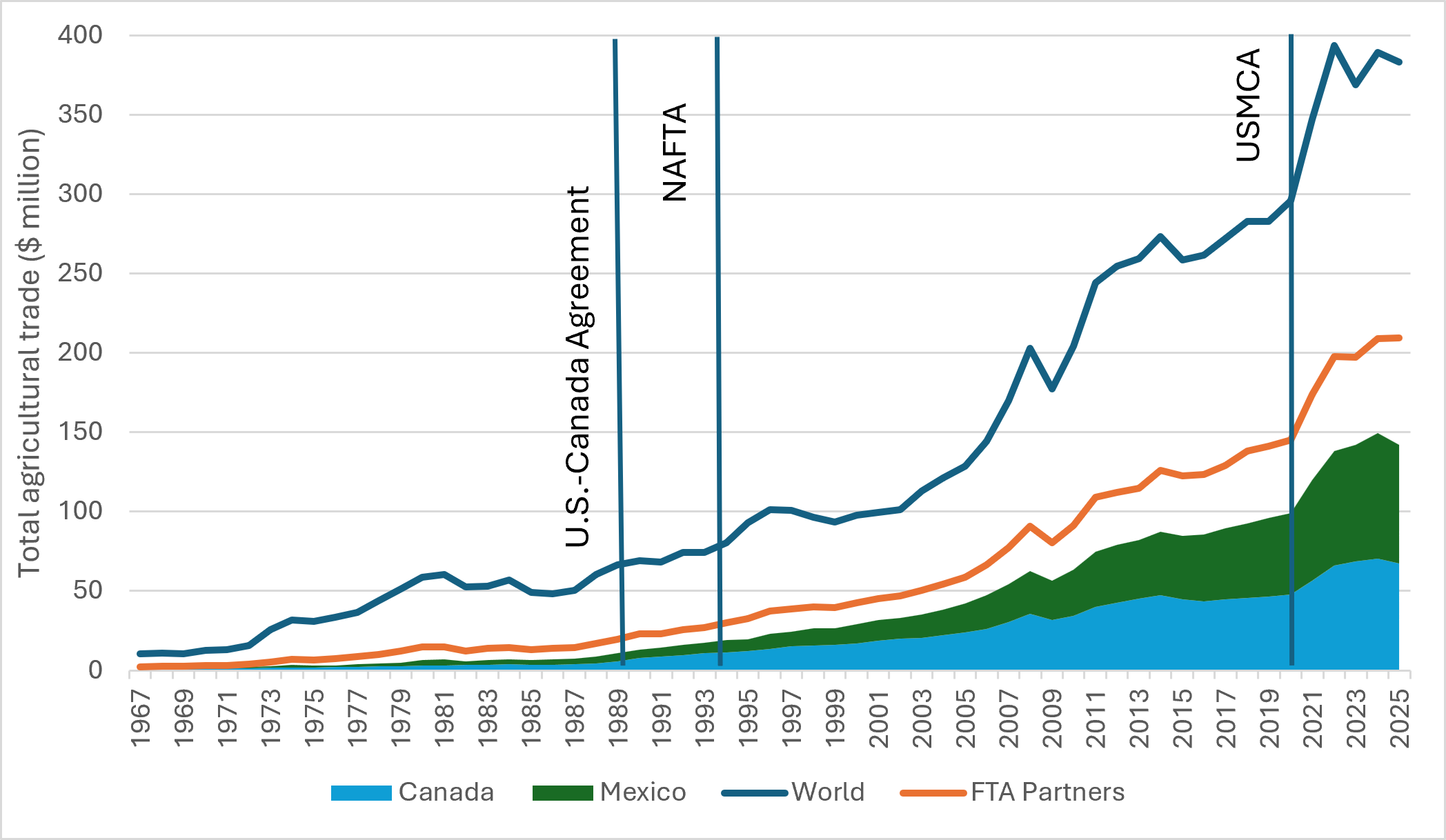
Figure 1. Total U.S. Agricultural Trade
Note: All trade numbers are cumulative
Source: FAS GATS
One important aspect for the United States in potentially changing USMCA is that Canada and Mexico import higher value products, on average, than other FTA partners and the world. The United States is predominantly a bulk exporter of agricultural products (e.g., corn, soybeans, cotton) which tend to garner a lower value on the global market. The average value of U.S. agricultural exports was $764.94/metric ton in 2025, but exports to Canada/Mexico averaged $899.60/metric ton. Canada, in particular, imports higher value products (averaging $2,111.55/metric ton).
Some examples of high value products Canada imports are fresh fruits and vegetables and bakery goods. If tariffs change due to renegotiating or ending USMCA, it could cause Canada to reduce imports from the United States and perhaps import more from other FTA partners (such as the EU). In addition, many bordering U.S. states depend on Canada (and vice versa) for food imports as it is cheaper for some U.S. states to import from Ontario, Canada than from Idaho—in terms of potatoes, for example.
Agriculture isn’t a Monolith
While North American trade agreements have contributed significantly to growth across all three countries, interests within the agrifood sector are still far from unified.
California avocado growers, for example, have long pushed back against low-priced avocado imports from Mexico, arguing that Mexico has undermined the economic sustainability of California growers and has become a dominant player in the U.S. marketplace.
Meanwhile, tomato growers in the southeast who applauded the decision to terminate the 2019 Tomato Suspension Agreement with Mexico are at odds with western tomato growers and importers who believed it would cause U.S. consumers to pay more for their tomatoes.
Despite these tensions, there has been broad support among U.S. agricultural producers to renew USMCA.
Treaty Review Looms
In a recent WITA webinar, John Bode, president and CEO of Corn Refiners Association, noted that ”NAFTA redesigned the American grocery store” by increasing the range and affordability of products, like fresh produce, through integrating the North American market in food and agriculture. USMCA, building on NAFTA’s foundation, sought to modernize and strengthen food and agriculture in North America.
These North American trade agreements have helped Canada, Mexico, and the United States become more integrated in supply chains, including agriculture. Integration between the three countries is vital for ensuring global competitiveness but also allows consumers to enjoy lower prices and exporters to have markets that want their products.
Any changes that lead to higher trade barriers could reverse some of these benefits, disrupt supply chains, and narrow market access. With the six-year review due July 1 and President Trump signaling he may not renew, the trade framework that governs North American agriculture is at an inflection point.
Opinions expressed are solely those of the author and not the Yeutter Institute or the University of Nebraska-Lincoln.

Jayson Beckman is the Mike Yanney Yeutter Institute Chair and an Associate Professor in the Department of Agricultural Economics.
Trade Matters Newsletter
Enjoyed this blog? Sign up for our newsletter to stay informed on the latest trade updates and events from the Yeutter Institute!